
Dickinson County Arrest Records and Court Charges
A Dickinson County arrest record is the record of the arrest itself. It shows who was taken into custody, the agency that made the arrest, and the booking that followed. In Michigan, the sheriff and local police handle this side. An arrest does not decide guilt. It only starts the process. After an arrest, the Prosecuting Attorney reviews the police report and sets the formal charges. Those charges are filed with the court, where they become the court charge record. From that point the case belongs to the District Court or the Circuit Court, not the jail.
It helps to keep the two records apart. The arrest and booking side lives with the sheriff, and the jail roster and booking detail are covered on the Dickinson County inmate records page. The court charge record is what the prosecutor actually filed, and it is tracked through the case as it moves. Court charges after arrest can change, drop, or grow as the case develops. The full case file, with pleas, hearings, and the final outcome, sits on the criminal court records page.
How to Find Dickinson County Arrest Records and Charges
Charges show up in the public court file, not in a mugshot gallery. The main way to see them is the state court case search. Michigan runs one statewide portal for trial court cases, and Dickinson County cases appear inside it. Booking detail is different and sits with the jail.
- Open the MiCOURT Case Search portal.
- Search by the defendant's name, or by case number if you have it.
- Open the case and read the list of charges filed.
- Check each charge for its statute code, its level, and its current status.
State criminal history is a separate lookup. The Michigan State Police run a public search called ICHAT that rolls charges and convictions into one statewide report. It works for a broad check, though it does not show suppressed records or warrant information.
The online search does not hand you every document. When you need a certified copy of a charge or a case history, the clerk's office is the next stop. Felony charges route through the Circuit Court clerk, which shares a line with the County Clerk at (906) 774-0988. Misdemeanor charges route through the 95B District Court at (906) 774-0506. If a copy or a confirmation is still out of reach, a public-records request under Michigan's Freedom of Information Act, MCL 15.231, can go to the county or the prosecutor's FOIA coordinator.
Note: Michigan court rules bar posting document images online, so a case search shows the charge and its history without the actual scanned filings.
How Charges Get Filed After a Dickinson County Arrest
The court charge record begins when the prosecutor files a charging document. In Dickinson County, most criminal matters start with a complaint after the police send their report to the Prosecuting Attorney. The prosecutor can authorize the complaint, deny it, or send it back for more work. If it is authorized, the District Court can issue a warrant and the arrest follows. Felonies take an added step. A preliminary exam is held within 14 days, and if the judge finds probable cause the case is bound over to the Circuit Court, where an information is filed. Three charging documents do most of this work.
The county's court process page lays out how a complaint moves from the police to the prosecutor and into court.
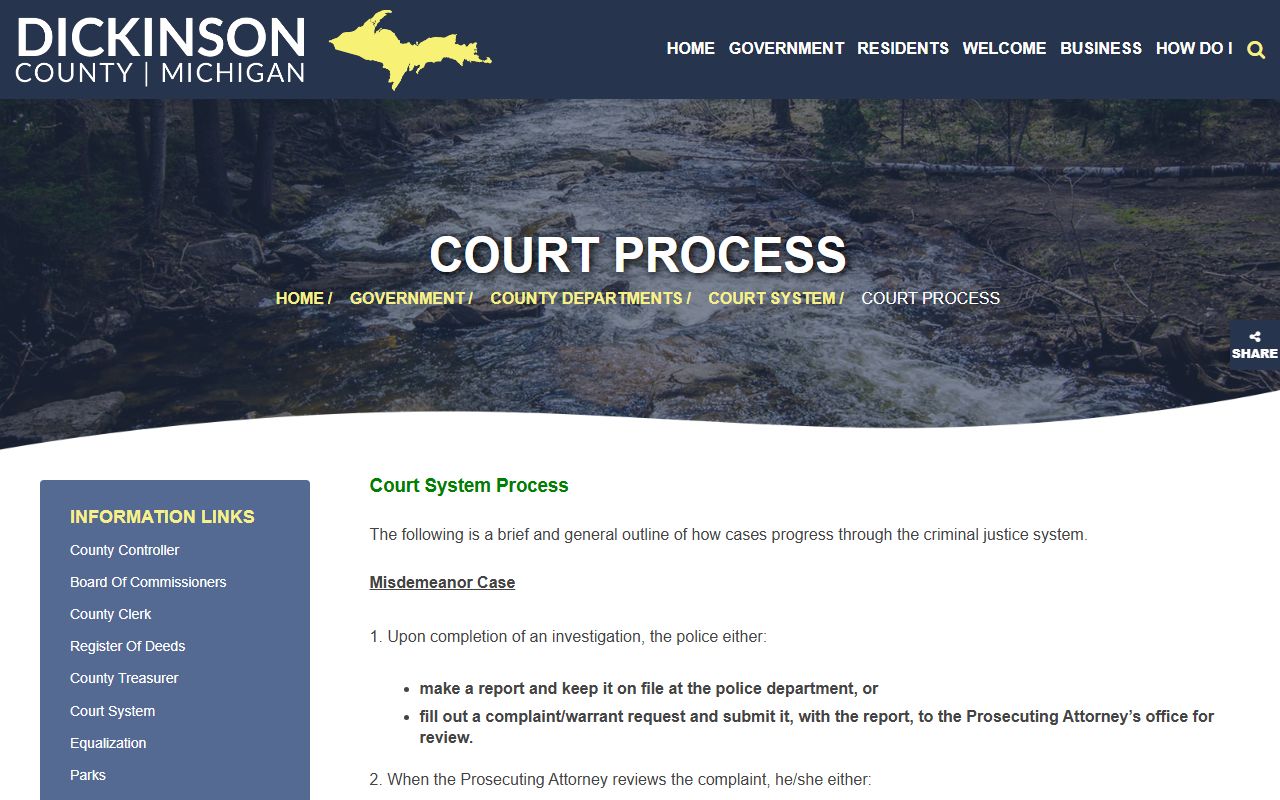
That local guide is the clearest county source for the path from a warrant request to an arraignment. The table below sorts the three main charging documents by who files them and where they land.
| Complaint | Information | Indictment | |
|---|---|---|---|
| Filed By | Officer / Prosecutor | Prosecutor | Grand Jury |
| Common For | Misdemeanors | Felonies after bindover | Serious felonies |
| Court | District Court | Circuit Court | Circuit Court |
| Starts | The case | The felony trial phase | The case |
Who Files Charges in Dickinson County
Charges are the prosecutor's call, not the arresting officer's. The Dickinson County Prosecuting Attorney, Lisa Richards, decides what to file and at what level. The office weighs the evidence and the statute before a charge is set. This is why an arrest for one thing can turn into a different charge, or no charge at all. The prosecutor works from the Prosecuting Attorney's Office on East D Street in Iron Mountain. Once a charge is filed, it is the county, through the prosecutor, that carries the case, not the person who reported the crime and not the victim.
The court and the prosecutor sit on different sides of the same case. The District Court handles the arraignment and misdemeanor pleas. At the arraignment, the defendant hears the charge and may plead guilty, not guilty, or no contest. The Circuit Court takes felonies after the preliminary exam. The prosecutor files and argues the charges in whichever court holds the case. A charge can be added, amended, or dropped at almost any stage before it is resolved.
Charge Status on a Dickinson County Court Record
A charge is not fixed once it is filed. As the case moves, the status of each charge is updated in the court file. Some charges stay open for months. Others are changed, merged, or dropped as part of a plea. The terms below appear often on Michigan court records.
| Status | What It Means |
|---|---|
| Pending | The charge is filed and the case is open. No plea or verdict has been entered yet. |
| Amended / Reduced | The prosecutor changed the charge, often to a lower level as part of a plea deal. |
| Dismissed | The court dropped the charge, so it will not go forward. |
| Nolle Prosequi | The prosecutor chose not to pursue the charge and withdrew it. |
Note: A dropped or dismissed charge still leaves a trace in the court file, since the record shows the charge was filed and later resolved.
Dickinson County Charge Codes and Severity
Every charge is tied to a Michigan statute. The court record lists the statute number next to the charge so the exact offense is clear. The number also fixes the severity level. Michigan sorts offenses into a few broad classes, and one arrest can produce several separate charges at once.
- Felony: an offense that can carry more than one year in prison, heard in the Circuit Court.
- Misdemeanor: a lesser offense, often with jail up to 93 days or one year, heard in the District Court.
- Civil infraction: a non-criminal violation, such as many traffic matters, that carries a fine rather than jail.
- Habitual offender notice: an add-on that can raise the possible sentence when a person has prior felonies.
Reading the code and the level together tells you how serious the county treats each count.
Note: A single arrest can lead to several charges at once, so a case file may list multiple counts tied to different Michigan statutes.
Charges vs. Convictions
Being charged is not the same as being convicted. A charge is an accusation. A conviction is the result after a plea or a trial. Many charges never end in a conviction, and the record can show a dismissal or an acquittal.
| Charge | Conviction | |
|---|---|---|
| Stage | Accusation | Verdict or plea |
| Burden of Proof | Probable cause | Beyond a reasonable doubt |
| Decided By | The prosecutor | The judge or jury |
| Public Record | Yes | Yes |
Statewide Charge and Criminal History Lookups
Charges filed across Michigan roll up into one statewide criminal history. The Michigan State Police keep that history and open part of it to the public through ICHAT.
The Michigan State Police ICHAT service is the state's public criminal history search.
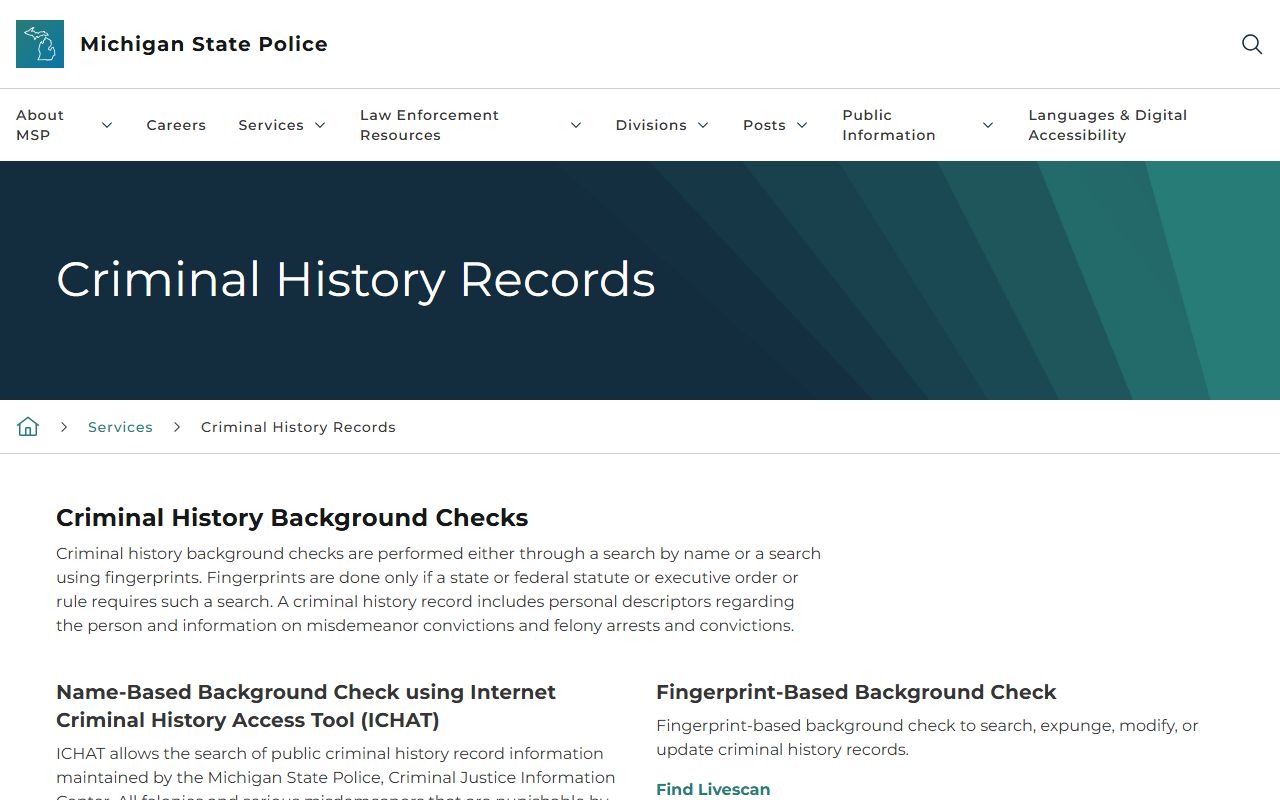
It returns public conviction and charge data statewide, but it will not show suppressed records or any warrant information. ICHAT is a paid, name-based search and works best for a broad check. For a single Dickinson County case, the court case search is more direct. Neither one replaces the other. The court file shows the case in detail, and the state history shows the wider record.
Note: ICHAT is a statewide search, so it can surface charges from other Michigan counties that a single Dickinson County case lookup would miss.
Sealed vs. Expunged Records
Some charge records are pulled from public view. Michigan lets certain convictions be set aside, and juvenile records are closed by default. A sealed record and an expunged record are not the same thing.
| Sealed | Expunged | |
|---|---|---|
| Visibility | Hidden from public view | Set aside, treated as though it never happened |
| Law Enforcement | Limited access remains | Very limited access |
| Michigan Basis | Court order under the court rules | MCL 780.621 set-aside series |
| Eligibility | Case by case, by court order | Set by statute, with waiting periods |
Background Checks and Dickinson County Charge Records
There is a difference between a casual name search and a formal background check. A formal check for a job, a rental, or a license must follow the federal Fair Credit Reporting Act. That law sets rules for accuracy, consent, and how old records can be used. A quick look at a court file does not carry those protections, and it can be out of date the moment a charge changes.
Important: This site is not a consumer reporting agency under the FCRA, and its information cannot be used for employment, housing, credit, or any other FCRA-regulated decision.
Restricted Charge Records in Dickinson County
Not every charge shows up in a public search. Michigan closes several categories to protect people and ongoing work. Juvenile charges are open only by court order under MCL 712A.28. Charges that were dismissed or set aside can be pulled from view, and open investigations are held back until a charge is filed. A suppressed case will not appear in ICHAT or in an ordinary name search.
Michigan's set-aside statutes, including MCL 780.621d, spell out how eligible convictions can be cleared.
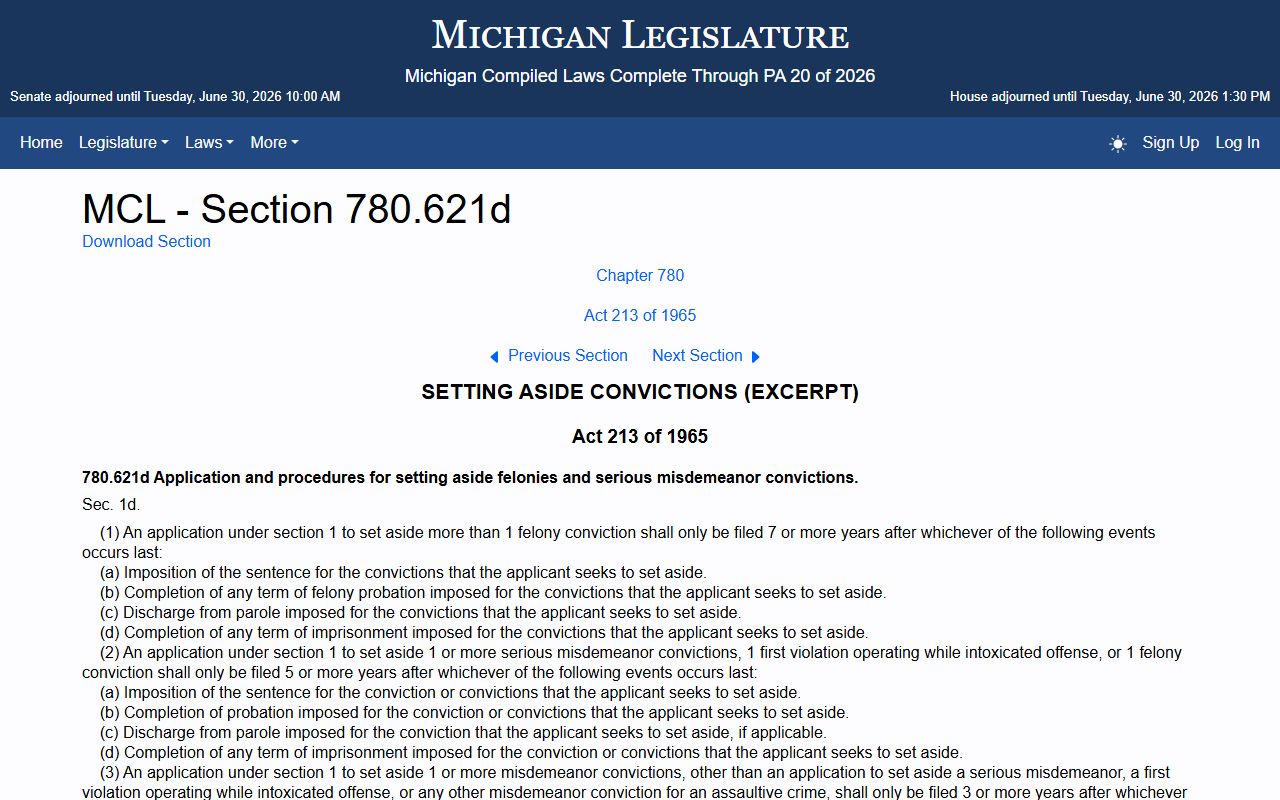
Once a conviction is set aside, it is treated as though it never happened, so it drops out of the public record. When a charge record is missing or unclear, a call to the court clerk or a public-records request to the county can confirm what is held and what is closed. In Dickinson County, only the county, sheriff, or prosecutor FOIA coordinator answers those requests, and the county may add ten business days before it responds.