
Dickinson County Warrant Search Options
Dickinson County publishes no county warrant list. No official county page carries a searchable roster of open arrest or bench warrants. That gap surprises many people, but it does not leave you stuck. You still have a clear path to check whether a warrant exists.
The route runs through a handful of public channels. You can call the sheriff, look up the underlying case on the statewide court portal, or file a records request. Each channel answers a slightly different question, and together they cover most needs. The sections below walk through each one and explain what a warrant is, where it comes from, and how to act on it.
Start here: With no online warrant list, the fastest checks are a call to the Dickinson County Sheriff at (906) 774-6262 or the jail line at (906) 774-6270, followed by a name search of the linked case in MiCOURT.
How Warrants Issue in Dickinson County
Most warrants trace back to the criminal case flow. A warrant does not appear on its own. It is the result of police work, a prosecutor's review, and a judge's signature. The county court process page lays out the steps in plain terms, and the path helps explain why a warrant links to a case.
Here is the usual order for an arrest warrant in the county.
- Police finish an investigation and write a report.
- Police submit a complaint or warrant request to the Prosecuting Attorney.
- The prosecutor reviews it, then authorizes it, denies it, or sends it back for more work.
- If the prosecutor authorizes the complaint, the district court issues the warrant.
- Officers make the arrest, and the defendant is arraigned in the district court.
Felony cases start the same way. After the district court arraignment, a preliminary exam is held, and if a judge finds probable cause, the case is bound over to circuit court. The warrant itself, though, comes from that first authorized complaint.
Note: A warrant request that the prosecutor denies or returns for more work does not become an active warrant, so no arrest order exists at that stage.
Types of Dickinson County Warrants
Not every warrant means the same thing. The reason a court signs an order changes what police can do and how you clear it. The county legal-terms page defines a warrant and the related steps, and the main kinds break down as follows.
- Arrest warrant
- Issued when the prosecutor authorizes a criminal complaint, letting police take a named person into custody.
- Bench warrant
- Ordered by a judge from the bench when a person misses a hearing or ignores a court order.
- Search warrant
- Signed by a judge or magistrate on probable cause, allowing police to search a place or seize property.
- Capias or failure to appear
- A bench warrant tied to a missed court date or an unmet duty in a pending case.
An arrest warrant flows from a fresh charge. A bench warrant grows out of a case that is already open. Both can lead to a booking at the county jail, so both are worth checking before you travel or apply for a job.
How to Check for a Dickinson County Warrant
Because there is no public warrant roster, you work the fallback chain. Each step below points to a real public channel in Dickinson County or across Michigan. Start with a phone call, then move to the case record, then use a formal request if you need a copy.
- Call the sheriff's main line or the jail line and ask whether a person is wanted or in custody.
- Search the linked case by name on the statewide MiCOURT case lookup.
- File a FOIA request with the county, sheriff, or prosecutor coordinator for a copy or a written confirmation.
- Open the Dickinson County Sheriff app for public safety alerts and its most-wanted postings.
The clearest way to reach the sheriff's office is through the department's own page. You can review its duties and contacts on the Dickinson County Sheriff's Department page before you call. That page confirms the jail is part of the sheriff's office and gives the lines you need.
Dickinson County Sheriff's Office
300 East D Street
Iron Mountain, MI 49801
Sheriff: Aaron Rochon
Main line: (906) 774-6262
Jail line: (906) 774-6270
Fax: (906) 774-2604
Emergency: 911
The Michigan Courts search surface also returns warrant-related results across the state, which is a useful sanity check when you know only a name. You can see the layout on the Michigan Courts warrant search results page, then repeat the same idea inside the county case record.
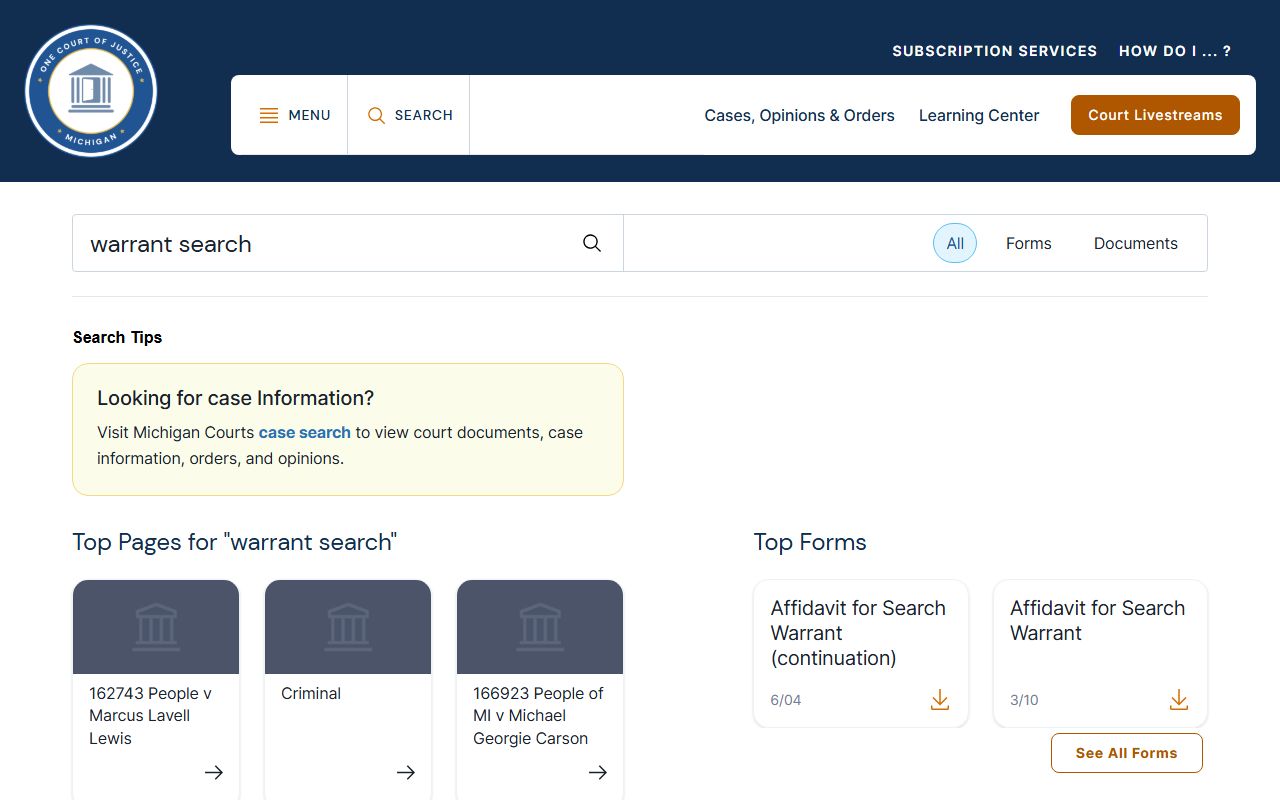
The results screen mixes cases, opinions, and orders, so treat it as a pointer rather than a live warrant list. To confirm a Dickinson County warrant, you still return to the sheriff or the underlying case file.
Michigan Courts Warrant Search Fields
Michigan does not offer a public field that reads "warrant" on its own. Instead, you search the criminal or traffic case that a warrant is attached to. The MiCOURT case search and the wider Michigan Courts search share the fields below, framed here as the closest public portal for a Dickinson County warrant check.
| Field Label | Type | Required | Notes |
|---|---|---|---|
| Last Name / Party Name | Text | Yes | The main entry point; the search covers the case, not a standalone warrant list. |
| First Name | Text | No | Narrows results for common surnames. |
| Case Number | Text | No | Use it if you already know the criminal or traffic case number. |
| Court / Lower Court | Select | No | Choose a Dickinson County court to limit results. |
| Case Type | Select | No | Filter by criminal, traffic, civil, domestic, or probate. |
| Attorney Name / Bar Number | Text | No | Finds cases tied to a named attorney. |
| Date Filters | Date | No | Limit results by a filing or disposition date range. |
An "all warrants" style query on the statewide surface pulls a broad mix of records, which is why the case-based fields matter more for a real check. The Michigan Courts all warrants search shows how wide that net can be.
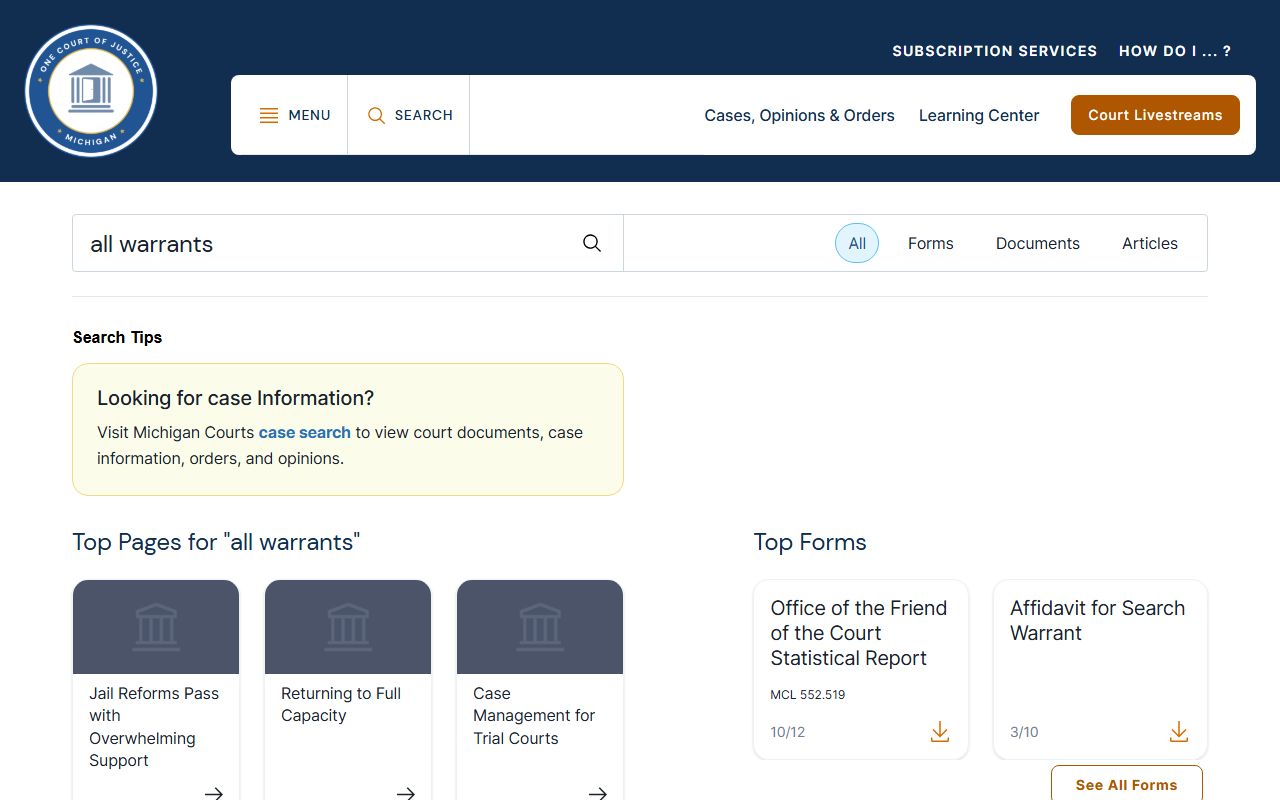
Because that broad view is not a county roster, narrow it by name, court, and case type. Then read the matching Dickinson County case to see whether a live warrant is noted in the docket.
Warrant Records vs Dickinson County Criminal Cases
A warrant is one paper in a much larger file. It orders an arrest or a search, and then it is done. The full story of pleas, motions, hearings, and the final outcome lives in the case record, not in the warrant.
That split matters when you plan your next move. If you want the charge, the sentence, or the disposition, read the whole file rather than the order. Those details sit in the Dickinson County criminal court records, which track a case from the first charge through judgment. The warrant simply starts, or restarts, that process.
Note: A warrant can be recalled or quashed while the underlying case stays open, so an old arrest order does not always mean a person is still wanted today.
What a Dickinson County Warrant Record Shows
When you do reach a warrant, whether by phone, through the court, or in a FOIA response, the document carries a set of standard fields. The inventory below reflects the data points a Michigan warrant and its linked case usually hold.
| Field | What It Shows |
|---|---|
| Warrant Type | Whether the order is an arrest, bench, or search warrant. |
| Issuing Court | The Dickinson County court that signed the order, usually the district court. |
| Issue Date | The date a judge or magistrate authorized the warrant. |
| Underlying Charge | The offense or the case reason behind the order. |
| Bond or Bail Amount | The amount, if any, set for release after arrest. |
| Case Number | The linked criminal or traffic case in the court file. |
| Status | Whether the warrant is active, served, recalled, or quashed. |
These same fields tie a warrant to the rest of the case. The charge, the bond, and the case number all point back to a court file you can follow over time.
ICHAT and Warrant Information Limits
Many people assume Michigan's public criminal history tool covers warrants. It does not. The Michigan State Police ICHAT service searches public criminal history record information, yet the state says plainly that ICHAT does not show suppressed records or warrant information.
That limit is easy to miss. A clean ICHAT result does not prove a person has no open warrant. It only means the public history search returned nothing suppressed. For warrant status, you still call the sheriff or read the case docket. The law enforcement network known as LEIN does hold warrant data, but LEIN is closed to the public and open only to law enforcement.
So treat ICHAT as a criminal history check, not a warrant check. The two answer different questions, and only the sheriff and the courts confirm a live warrant in Dickinson County.
What to Do About an Outstanding Dickinson County Warrant
An open warrant does not fix itself, and it can lead to an arrest at a traffic stop or a routine contact. Acting early gives you room to plan. The steps below help you handle a warrant with care rather than by surprise.
- Talk to a criminal defense lawyer before you do anything else.
- Confirm the warrant and its terms through the court or the sheriff.
- Arrange bond money if the warrant lists a bail amount.
- Plan a voluntary appearance or surrender with your attorney present.
A planned surrender often goes more smoothly than an arrest in public. For misdemeanor, non-security-risk cases, the district court can assign the Work Van program in lieu of jail, which shows the range of outcomes a case may hold. Your lawyer can explain which paths fit your situation.
Important: Speak with a defense attorney before you turn yourself in, since a lawyer can arrange bond, set a court time, and protect your rights during the process.
If a person is already booked, the jail line is the fastest way to confirm custody and the next hearing. Custody status and booking details sit with the sheriff, and the Dickinson County inmate records page explains those channels in more depth.
Setting Aside Dickinson County Criminal Records
Once a case closes, Michigan law may let a person set aside a conviction, which limits later public access to the record. That process can also affect how old warrants and their cases appear in searches. Several statutes work together to define who qualifies and what the effect is.
The set-aside rules run through a series of linked sections. One key provision appears on the MCL 780.621e statute page, which sits within the state's expungement framework.
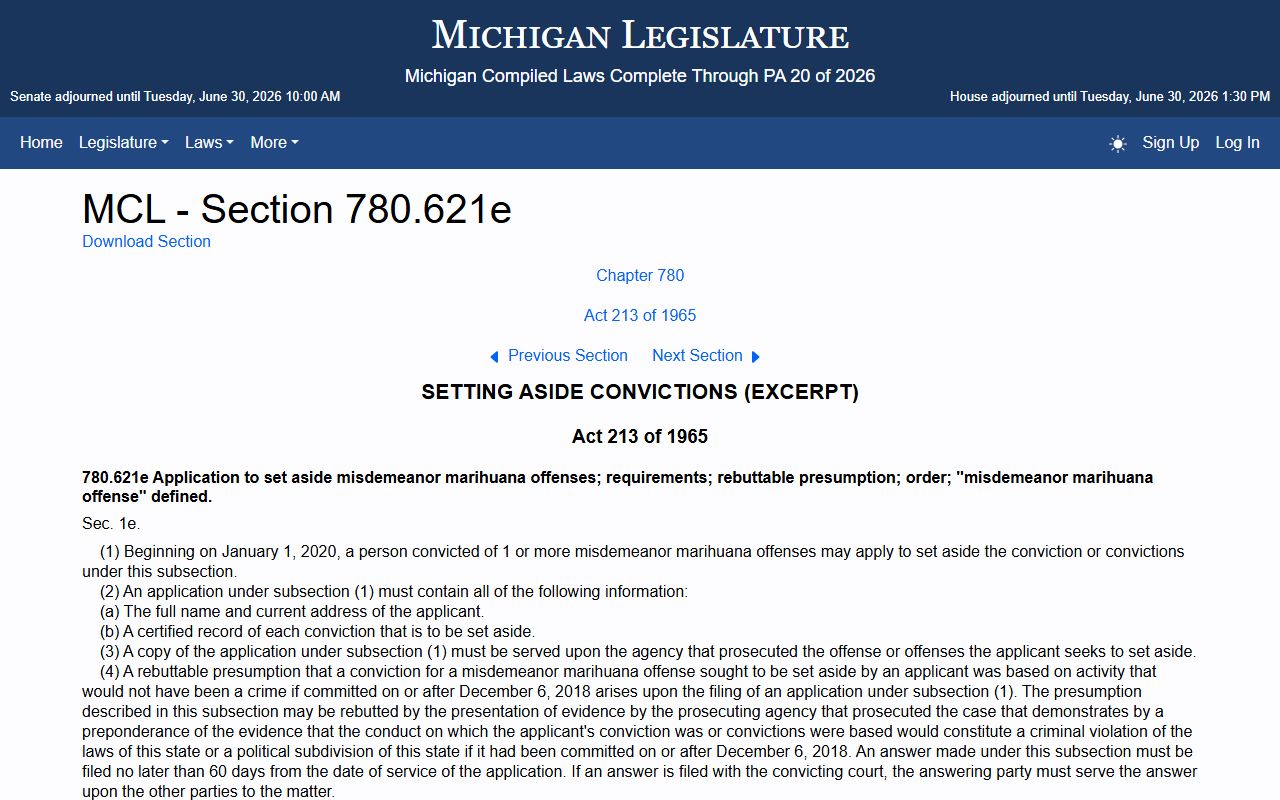
Reading the actual statute helps you see the limits and the timing rules that apply. The next section in the chain builds on those terms and adds further conditions.
The following provision continues the framework and is published on the MCL 780.621f statute page. It works alongside the earlier sections to shape how a set-aside is granted and recorded.
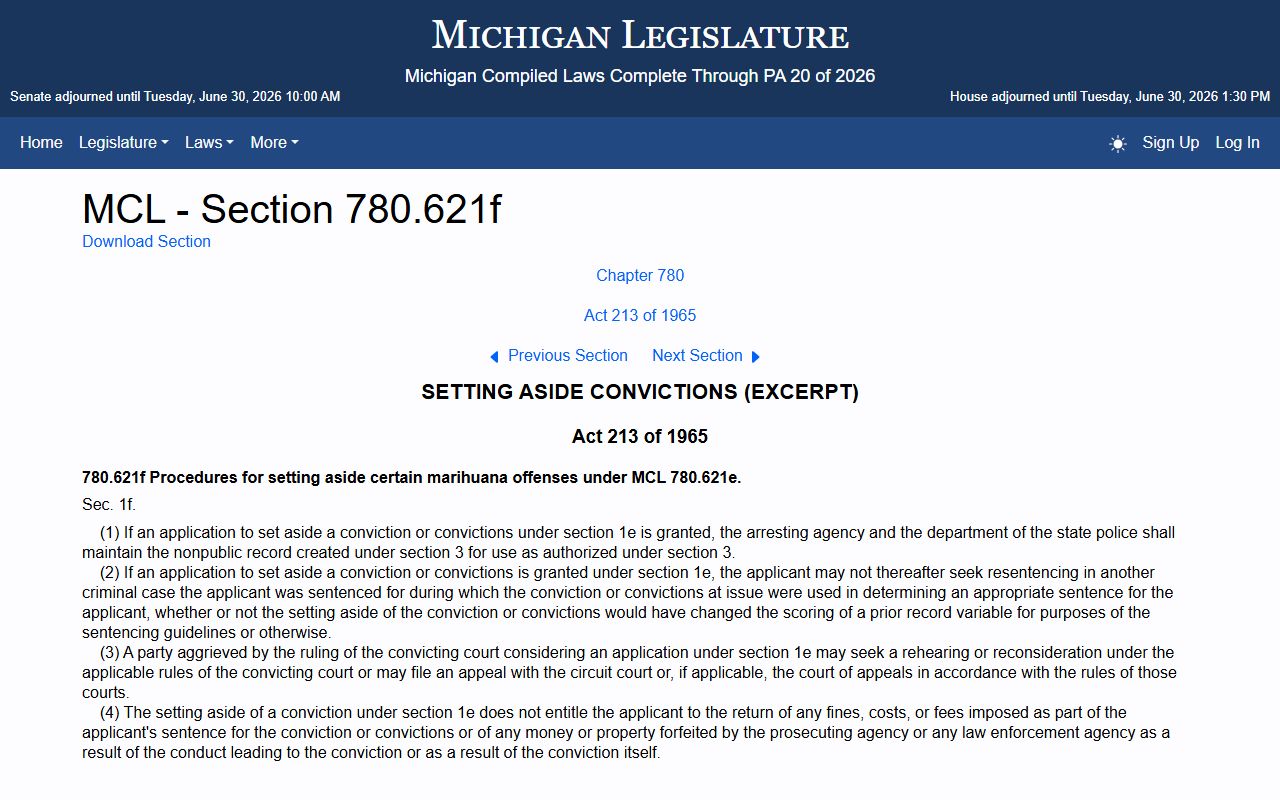
Together these sections explain why a public case search may not return every record a reader expects. A set-aside can block ordinary access even when the case once appeared in results.
Note: A set-aside changes public access to a closed case, but it is a court process with strict eligibility rules, so it does not erase every trace on its own.
Restricted and Sealed Dickinson County Warrants
Some warrants and cases never reach the public at all. Michigan court rules let a court seal records or make them nonpublic, and separate statutes wall off entire categories. That is why a name search can come up empty even when a matter exists.
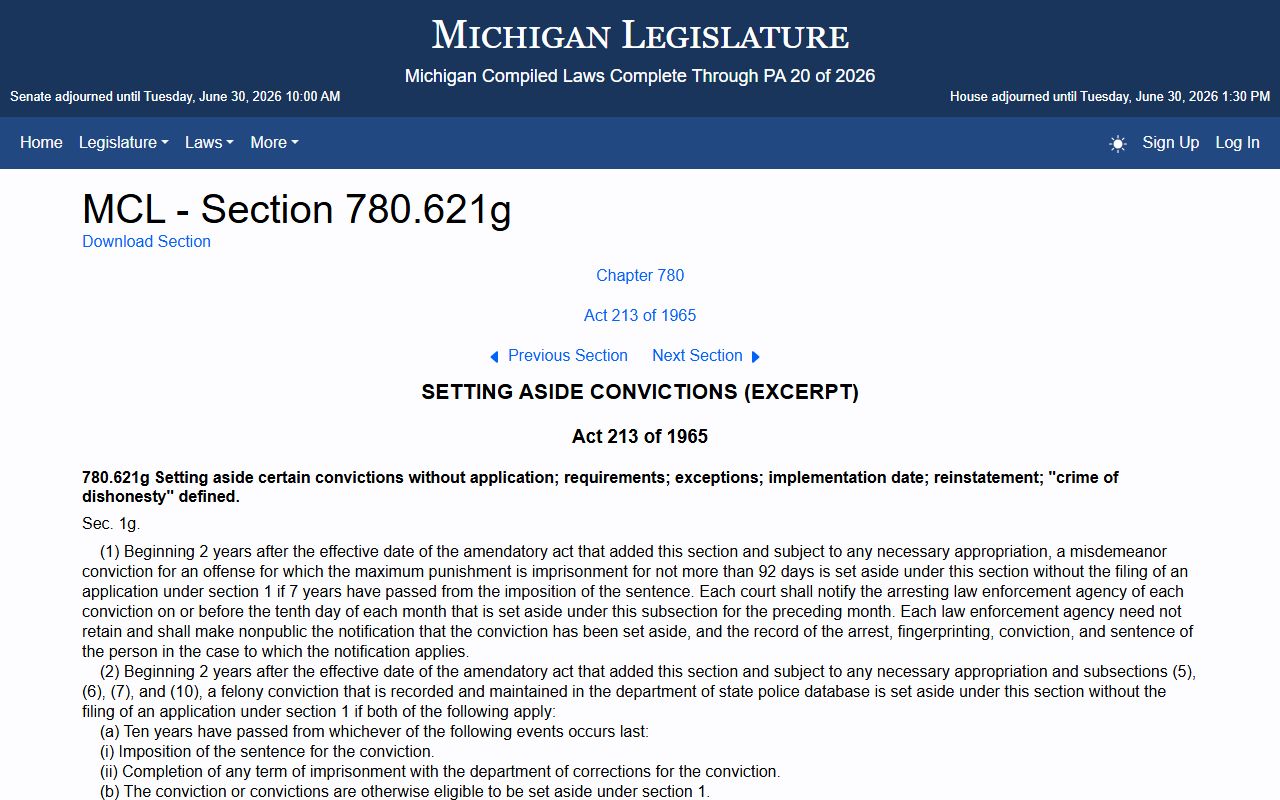
Juvenile files are the clearest example. Under MCL 712A.28, juvenile records are open only by court order, so a juvenile warrant or case does not show in an ordinary public search. The automatic set-aside process rounds out this framework, and it appears on the MCL 780.621g statute page.
Beyond juvenile and set-aside limits, court rule MCR 8.119 controls how records are kept and when they can be sealed, and it directs that document images not be posted online. Sealed search warrants may stay nonpublic while an investigation is open, and federal warrants run through the federal court system rather than the county. For those matters, the sheriff, the district court clerk, or a FOIA request remains the right path in Dickinson County.