
Criminal Court Records in Dickinson County
A criminal court record is the case file the court opens once a charge is filed. It is more than an arrest note. It holds the complaint, the arraignment, every plea, each motion, the hearings, and the outcome. In Dickinson County, the case file is kept by the court that handles the matter and by the County Clerk, who has served as keeper of county records since 1891. The file grows as the case moves. Each entry is dated. Together the entries form the docket, which is the running log of what the court did and when.
Two trial courts handle criminal matters here. The 95B District Court hears misdemeanor offenses, the less serious crimes that carry shorter jail terms. The 41st Circuit Court hears felonies, the serious crimes that can carry prison time. The district court also screens felonies at the start, before they move up. The county courts page lays out which court does what. The prosecuting attorney decides what charges to bring, and the district court screens each felony before it moves up.
How to Search Dickinson County Criminal Court Records
The main public tool is the statewide MiCOURT Case Search. It covers criminal, civil, traffic, domestic, and probate cases from Michigan trial courts, and Dickinson County cases appear in it. The county does not run its own online docket, so MiCOURT is the first stop for most name and case-number lookups.
- Open the MiCOURT Case Search portal.
- Search by a defendant name or an exact case number.
- Narrow the search by court, case type, and case year.
- Open the matching case to read the docket, pleas, and disposition.
- Request a certified copy from the County Clerk when a signed record is needed.
The search form offers many filters. The table below lists the fields most people use to find a criminal case. Not every field is required, and one strong term is often enough.
| Field | Type | Notes |
|---|---|---|
| Case Number | Text | Exact number if known |
| Party / Last Name | Text | Search by defendant name |
| First Name | Text | Used with a name search |
| Court / Lower Court | Dropdown | Pick district or circuit |
| Case Type | Dropdown | Criminal, traffic, and more |
| Case Status | Dropdown | Open, closed, disposed |
| Public Status | Dropdown | Public or suppressed |
| Offense Date Range | Date | Filters by offense date |
A statewide criminal history is a separate search from a single case file. Michigan runs that lookup through a state agency, and it draws from records across all counties, not just this one. It is covered further down.
Stages of a Dickinson County Criminal Case
A criminal case moves through set stages, and each stage adds to the record. The county court process page gives a clear local map of that path. It starts with police and ends with a sentence. Knowing the stages helps you read a docket, because each line in the file ties back to one of these steps.
Case flow: Charges Filed › Arraignment › Pretrial / Motions › Plea or Trial › Disposition › Sentencing
Here is how a case runs in Dickinson County, drawn from the county court process guide:
- Police finish an investigation and either keep the report on file or send a complaint and warrant request to the prosecuting attorney.
- The prosecutor reviews it and then authorizes the charge, denies it, or sends it back for more work.
- If authorized, the district court issues a warrant and the suspect is arrested.
- The defendant is arraigned in district court and hears the charge and rights.
- The defendant may plead guilty, not guilty, or no contest.
- A not-guilty plea sends the case to a pretrial conference, then a bench trial or jury trial.
- A guilty result leads to probation review and a pre-sentence investigation before sentencing.
Felonies take an added step. The district court arraignment does not close the case. A preliminary exam is held within 14 days, and it tests whether there is probable cause to go forward. If the judge finds it, the case is bound over to the 41st Circuit Court. The felony arraignment and later hearings then happen there. So a felony file can span two courts, and the record may carry both a district-court number and a circuit-court number.
Note: The county legal-terms page defines arraignment, bound over, preliminary exam, and plea bargain in plain language, which helps when a docket uses those words.
What a Dickinson County Criminal Court Record Shows
A criminal case file is built from fields that repeat across every case. Once you know them, any docket reads the same way. The table sets out the core fields and what each one tells you. Some fields fill in early, like the charge. Others fill in only at the end, like the sentence.
| Field | What It Shows |
|---|---|
| Case Number | The court file identifier, often with a type code such as FH or FC for a felony |
| Defendant | The person charged, listed as the party the state has accused |
| Court and Judge | Whether the case sits in the 95B District or 41st Circuit Court, and who presides |
| Charges | Each count as filed by the prosecutor, with the statute and the severity level |
| Plea | Guilty, not guilty, or no contest, plus any later change of plea |
| Hearings and Motions | Dated entries for arraignment, exam, pretrial, motions, and trial dates |
| Disposition | How each count ended: convicted, dismissed, acquitted, or reduced |
| Sentence | Jail or prison time, probation, fines, restitution, and other terms |
Not every document sits online. Under Michigan court rules, document images are not posted on the Internet, though the docket and case history can still be searched. To read a filed order or a full document, you often request a copy from the clerk. The docket tells you the paper exists and when it was filed.
Reading Dispositions in Dickinson County Records
The disposition is the outcome of a charge. The sentence is what the court orders after a conviction. A file can hold several dispositions at once, because a case can carry more than one count. Some counts end in a plea while others are dropped. The terms below appear often, and the county defines several of them on its legal-terms page.
- Guilty plea
- The defendant admits the charge, and the court moves to sentencing.
- Not guilty
- The defendant denies the charge, which sends the case toward trial.
- No contest
- The defendant does not fight the charge but does not admit it, and the court treats it much like a guilty plea for sentencing.
- Dismissed
- The charge is dropped, sometimes as part of a plea bargain on other counts.
- Pre-sentence investigation
- A probation review of the defendant that guides the judge before sentencing.
- Restitution
- Money the court orders paid to a victim as part of the sentence.
A sentence line can mix several terms. It may show jail time in the county jail, a probation period, a fine, and restitution together. Felony fines can be paid online in Dickinson County, a change the county noted in April 2021. Read the whole sentence block, since one count can carry conditions the others do not.
Charges vs. Convictions
A charge is an accusation. A conviction is a proven result. The two are not the same, and a criminal court record can show charges that were later dropped, dismissed, or ended in acquittal. A person can be charged and never convicted. The file keeps both, so read to the disposition before drawing a conclusion about any count.
| Charge | Conviction | |
|---|---|---|
| Stage | Accusation at filing | Verdict or plea at the end |
| Who Acts | Prosecuting attorney | Judge or jury |
| Burden of Proof | Probable cause | Beyond a reasonable doubt |
| Public Record | Yes | Yes |
| Can Change | Amended, reduced, dropped | Final unless appealed |
The charge side of a case is covered in more depth on the arrest and charge records page. The full file, with the plea and the sentence, is the criminal court record described here.
Statewide Criminal History and Dickinson County Records
A single case file answers one question. A statewide criminal history answers a broader one. Michigan runs two very different systems, and only one is open to the public. The public tool is ICHAT, the state criminal history check run by the Michigan State Police. It draws from records across all counties. It does not show suppressed records or warrant details, so it can miss what a name search expects to find.
The other system is LEIN, the Law Enforcement Information Network. It is a state network for police and courts, not a public search. You can learn how it works from the state's LEIN information page, which explains its role in Michigan's justice system.
Because LEIN is restricted, an ordinary reader cannot search it, but understanding it explains why police can see more than the public can. Support for the network runs through a state contact unit for the agencies that use it. The state's LEIN field services unit handles that help.
For most people, the path is simple. Use MiCOURT for a specific case, and use ICHAT when a full criminal history is the goal. Keep in mind that neither will surface a sealed file or a matter that a court has made nonpublic.
Sealed vs. Expunged Records
Not every criminal record stays open forever. Michigan lets some records be set aside, which is the state term for expungement. A sealed record is hidden from public view but still exists. An expunged record is set aside, so the law treats the conviction as though it never happened. Both limit what a public search returns, and both can explain why a case a reader remembers no longer appears.
| Sealed | Expunged | |
|---|---|---|
| Visibility | Hidden from public search | Set aside, treated as never occurring |
| Law Enforcement | Limited access remains | Very limited access |
| Governing Law | Court rules on nonpublic files | MCL 780.621 set-aside statutes |
| Eligibility | By court order in the case | By petition under state law |
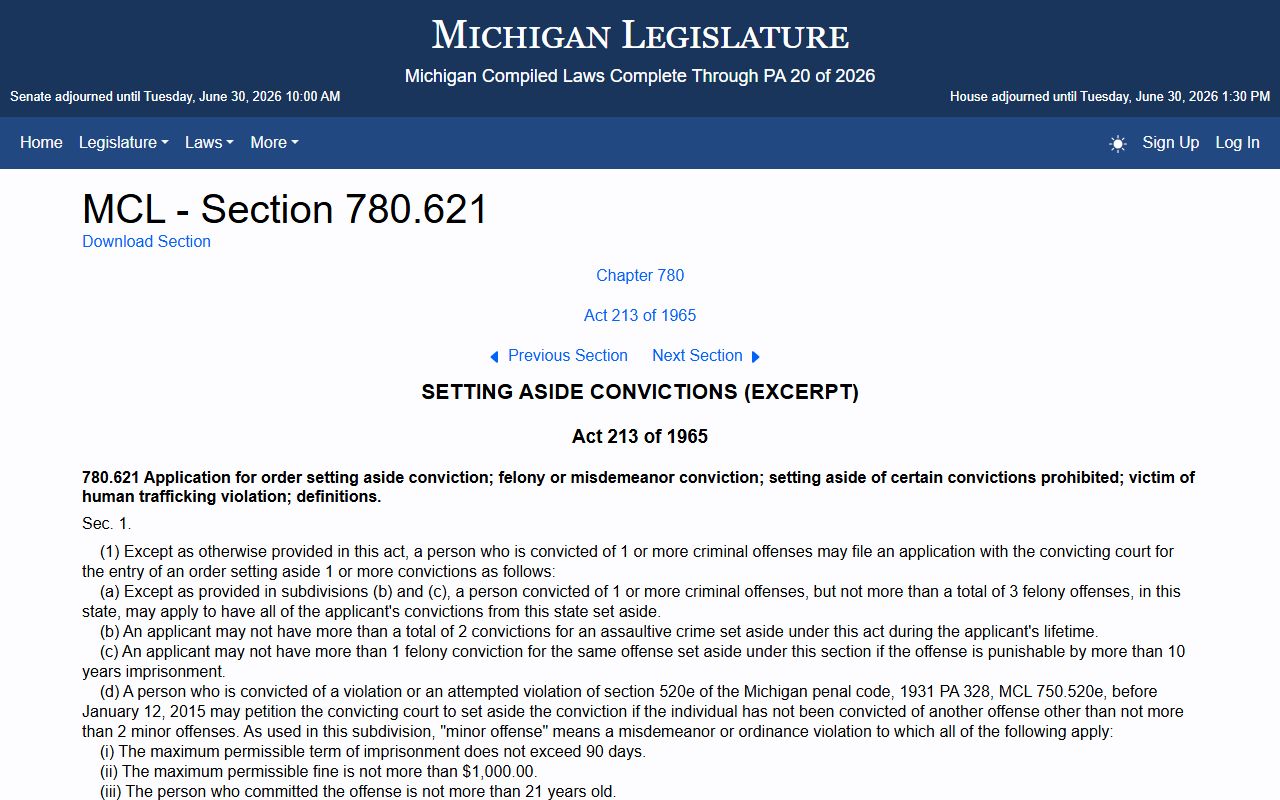
Michigan spells out the set-aside process in a series of statutes. The core rule sits in MCL 780.621, which sets who may apply to clear a conviction and how.
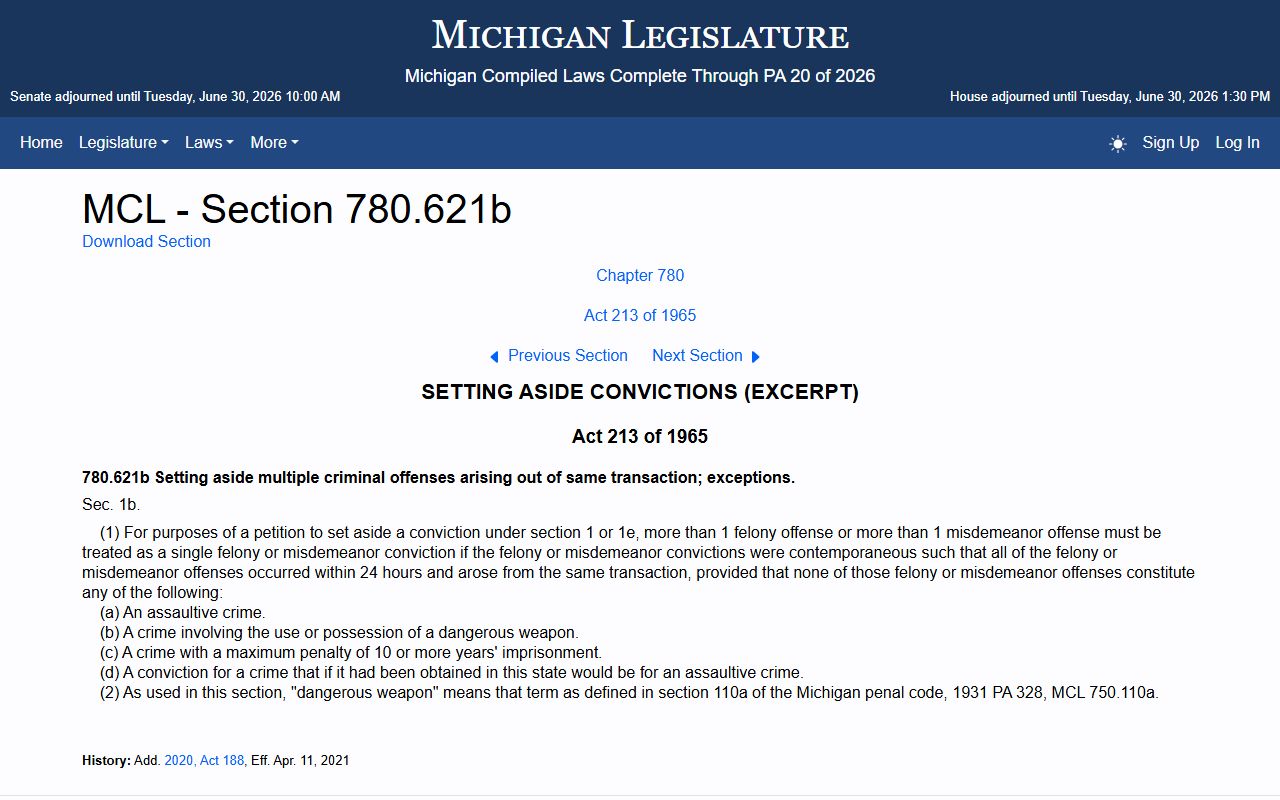
The follow-on sections refine the rules for specific record types and timelines. One such section, MCL 780.621b, adds provisions that shape which records qualify.
The chain continues with more detailed rules on eligibility and process. A later section, MCL 780.621c, further defines how set-aside relief applies.
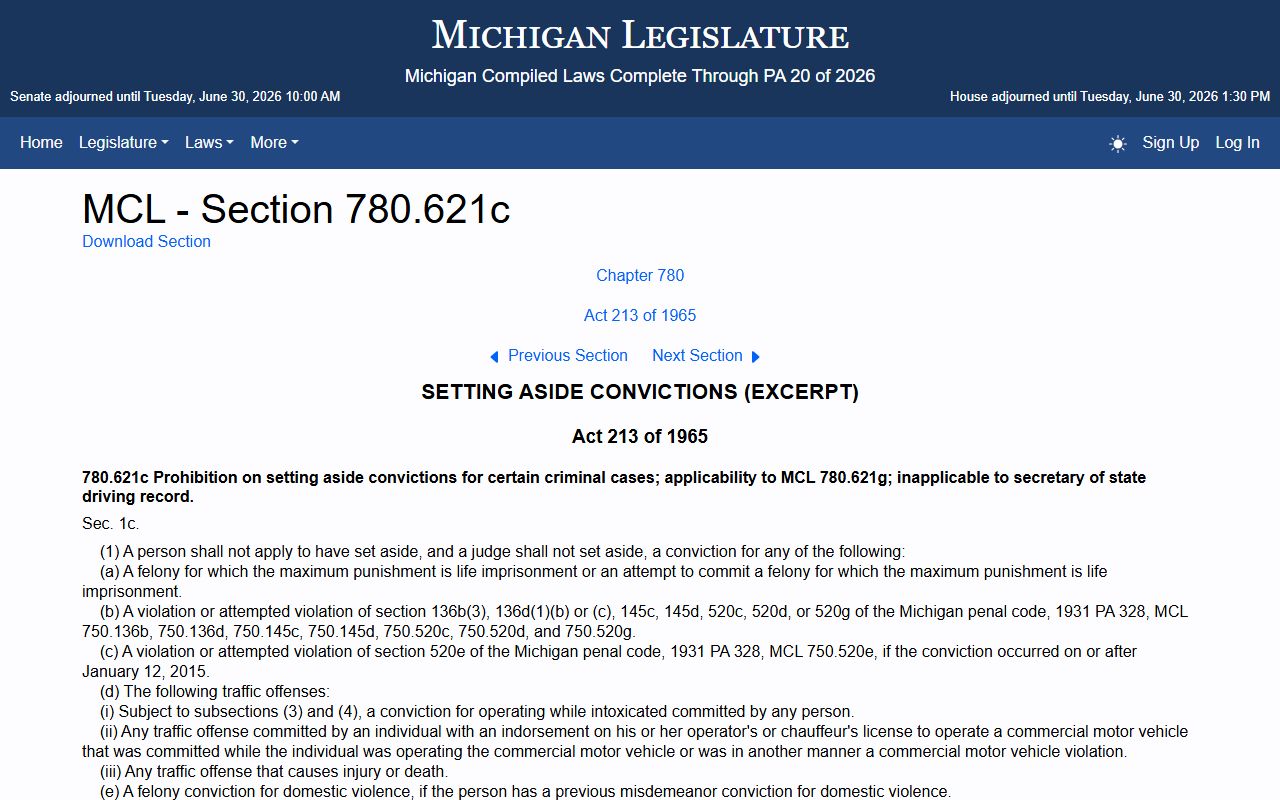
Note: A public case result can still exist even after a later set-aside blocks ordinary access, which is one reason a name search may not match a full history.
Public Access to Dickinson County Criminal Court Records
Michigan treats most court records as public. Two frameworks set the rules. The state Freedom of Information Act sets the baseline for public access to government records. The court rules set how court files are kept and who may see them. Together they make criminal case files broadly open, with limits for sealed and juvenile matters. When the portal does not return what you need, a records request to the right office is the next step.
Key Statutes:
Michigan Code § 15.231 - the state Freedom of Information Act, which declares the public's right to access government records.
MCR 8.119 records management - governs how courts keep records and why document images are not posted online.
Dickinson County handles records requests through a FOIA form that asks for a name, phone number, and mailing address. Only the county, sheriff, or prosecutor coordinator responds, and the county may extend its reply by ten business days. A good-faith deposit can be required when estimated fees top fifty dollars. For all case records across the county, the court records page maps the wider request path.
Background Check Considerations
People look up criminal records for many reasons. A casual name search is not the same as a formal background check. Formal checks used for hiring, housing, or credit fall under the federal Fair Credit Reporting Act, which sets accuracy and consent rules. A quick portal search does not meet that standard. For a decision that affects someone's job or home, use a compliant service and confirm the source.
Important: This site is not a consumer reporting agency under the Fair Credit Reporting Act, and its records may not be used for employment, tenant, credit, or insurance decisions.
Restricted Criminal Court Records in Dickinson County
Some criminal court records are closed to the public. Juvenile cases are the clearest example. Under MCL 712A.28, juvenile records open only by court order, so they do not appear in ordinary search results. Sealed cases and matters the court has made nonpublic are also hidden. Ongoing cases can show limited detail while they are still open.
Personal details can be redacted from public documents too, and victim information is guarded under the court rules. That is why a public docket may show a case exists yet withhold parts of the file. When a record seems missing, the reason is often a set-aside, a seal, or a juvenile status rather than an error. In those cases, a call to the County Clerk or a records request is the right next move.