
What Dickinson County Probate Court Handles
The Dickinson County Probate Court is one of the county's three trial courts. It hears cases about wills and estates, conservatorships, and guardianships. It also handles the commitment of people with mental illness to programs meant to help them. When a will is contested, the probate judge rules on whether the document is genuine and whether the signer was of sound mind.
Probate also decides who gets which share of a decedent's assets when that question is in dispute. Broader state guidance groups probate work as estates, wills, trusts, guardianships, and conservatorships. Most files open when someone dies, when an adult can no longer manage money or care, or when a minor needs a legal guardian. The court reviews petitions, appoints fiduciaries, and supervises how an estate is settled.
The scope is wide but the pattern is steady. A person dies with or without a will, and the court confirms who may act for the estate. A relative can no longer manage bills or medical choices, and the court weighs a guardian or conservator. A minor loses a parent's care, and the court decides who takes charge. Each of these paths creates a probate file in Dickinson County, and each carries its own forms, hearings, and access rules.
One local overlap is worth noting. Probate judges in Michigan may perform marriage ceremonies, so the same office tied to estates can also join a couple. Marriage licenses themselves come from the County Clerk, and those steps are covered on the marriage and divorce records page.
Dickinson County Probate Court Contact
The probate court shares the county courthouse campus in Iron Mountain with the circuit and district courts. Chief Judge Thomas D. Slagle presides over probate matters. Call the office to confirm a hearing date, ask about a filing, or check what a specific case requires before you visit.
Dickinson County Probate Court
705 S. Stephenson Ave.
P.O. Box 609
Iron Mountain, MI 49801
Phone: (906) 774-1555
Fax: (906) 774-1561
Hours: Monday to Friday, 8:00 a.m. to 4:30 p.m. Central
Chief Judge Slagle's court keeps the estate, guardianship, and conservatorship files opened in the county. Staff can point you to the right form or explain how to request a copy from a case they hold.
Note: Call ahead before a courthouse visit, since probate staff can tell you which documents are public and which need a court order to view.
Probate Terms Defined in Dickinson County Cases
Probate paperwork uses words that rarely come up elsewhere. A quick glossary helps you read a file or a form without guessing. These five terms show up in most Dickinson County estate and guardianship matters.
- Testator
- The person who made a will. The testator names who should inherit and who should carry out the plan.
- Executor
- The person named in a will to settle the estate. In Michigan this role is often called a personal representative.
- Intestate
- Dying without a valid will. State law then sets the order in which heirs receive the estate.
- Guardianship
- A court order giving one person legal authority over the care of a minor or an incapacitated adult.
- Conservatorship
- A court order placing a person's money and property under a conservator who manages those assets.
Guardianship covers the person and daily care, while conservatorship covers the money. A single case can involve both when someone needs help with care and finances at the same time.
How to Search Dickinson County Probate Records
There is no county-only probate docket database on the Dickinson County website. The two working channels are the local probate court and the statewide MiCOURT case search that Michigan courts run. MiCOURT can surface probate cases along with civil, criminal, traffic, and domestic matters. Public access can be limited when a file is sealed or marked nonpublic under court rules.
- Open the MiCOURT case search and pick a party-name or case-number lookup.
- Enter a last name, or the exact case number if you have it.
- Narrow the results by court, case type, or filing year.
- Open a matching case to read its parties, status, and events.
- Contact the probate court directly for records that do not appear online.
The search surface accepts several inputs, and knowing them saves time. The table below lists the fields the statewide portal offers.
| Search Field | What It Does |
|---|---|
| Case Number | Pulls one exact case when you know its number. |
| Party Name | Finds cases tied to a last name or full name. |
| Court Selector | Limits results to a chosen trial court or level. |
| Case Type or Category | Filters by matter type, such as probate or civil. |
| Date Filters | Restricts results to a filing period or range. |
| Public Status Filters | Reflects whether a record is open or nonpublic. |
If a case does not show online, the local court remains the surest route. Probate staff can confirm whether a file exists, whether it is public, and how to request a copy. A transcript, when one is needed, comes from the court recorder or reporter for the judge who heard the case, which is a useful fallback when the online docket holds no transcript. Michigan court staff follow a benchbook on when files stay open and when access is restricted. This guide on access to court files and records explains the standard staff use.
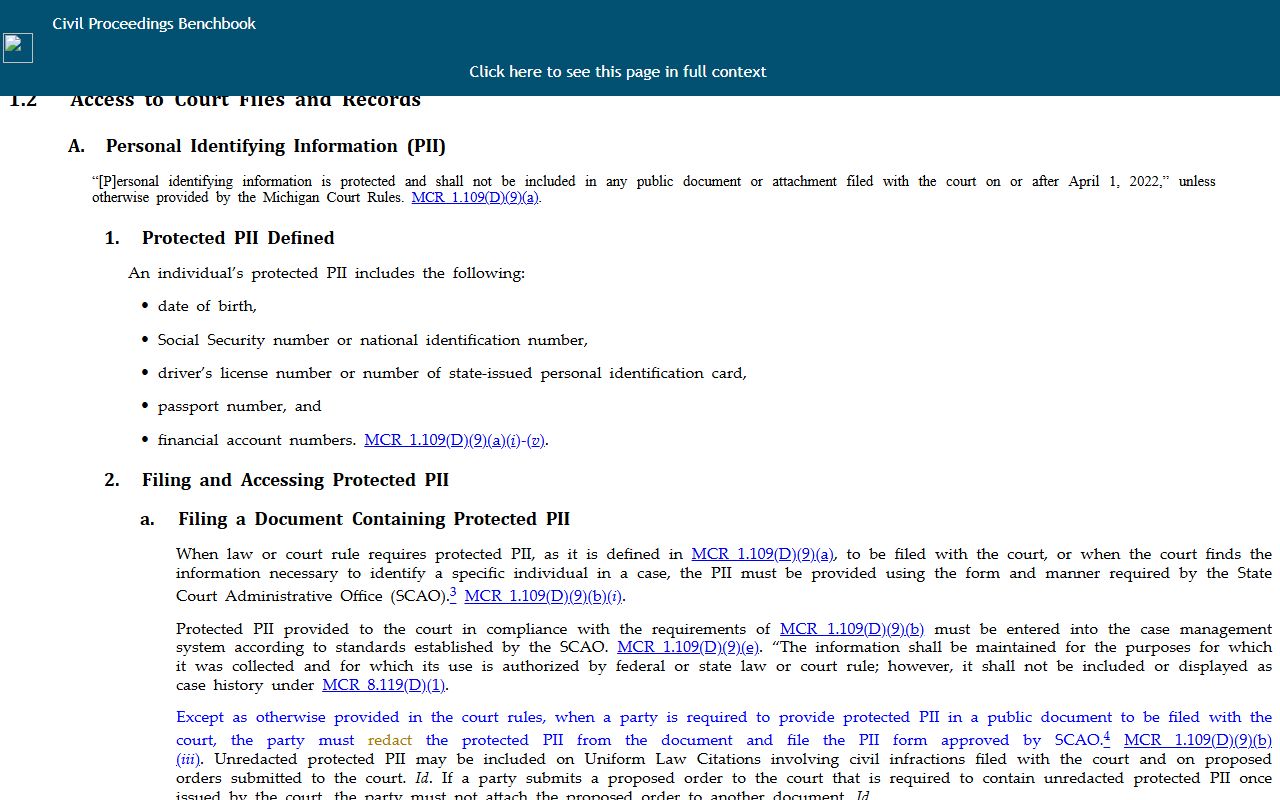
The reference shows why some probate documents are viewable at the counter while others need a judge's approval.
Probate Forms and Statewide Self-Help
Dickinson County points filers to the State Court Administrative Office for self-help forms. Michigan Courts hosts an Index of Probate Court Forms that serves every county, so a Dickinson County filer uses the same statewide packets as anyone else. These cover estates, guardianships, conservatorships, and related petitions.
The full set of fillable forms sits on the state site. You can review the Michigan probate court forms index before you file to confirm which document your matter needs.
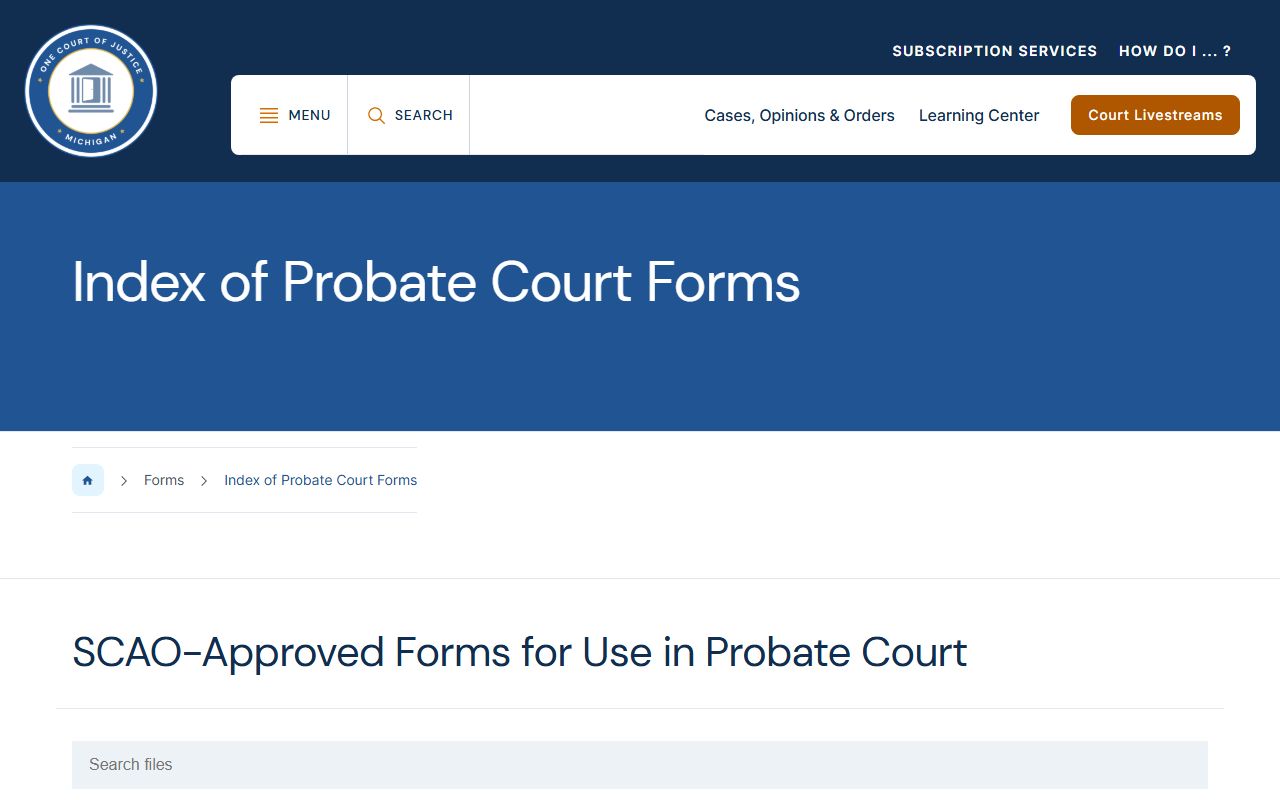
Picking the right form early prevents rejected filings and repeat trips to the courthouse in Iron Mountain.
Note: The statewide forms are free to download, but the probate court still decides which one your case requires, so confirm before you sign.
Dickinson County Probate Filing Fees
The county website does not publish a probate-specific fee schedule. Probate filing fees in Michigan are set by statute and the State Court Administrative Office, not by a local price list. For exact amounts on an estate, guardianship, or conservatorship petition, call the probate court. The table below shows what is set by the court and which nearby fees the County Clerk charges for records estates often need.
| Item | Amount or Authority |
|---|---|
| Estate, guardianship, or conservatorship filing | Set by state statute and SCAO; confirm with the probate court |
| Certified copy from a probate file | Set by the court; call (906) 774-1555 to confirm |
| Certified death certificate (County Clerk), often needed to open an estate | $20 for the first copy, $15 for each added copy |
| Death-record search (County Clerk) | $5 per decade searched |
| FOIA good-faith deposit for county records | Required when estimated cost is more than $50 |
The certified death certificate is a County Clerk vital record, not a probate charge, but many estates cannot open without one. Those copies and other clerk services are handled by the County Clerk office in the same courthouse.
Probate Venue and the Family Division
Venue in probate can depend on where the person lives, where they are present, or where their property sits. That rule decides which county court should hear an estate or guardianship. For most Dickinson County residents, the local probate court is the right venue.
Not every matter about a minor goes to probate. When a case involves a juvenile and arises out of a protective proceeding, a delinquency proceeding, or a domestic-relations custody case, the Family Division of the 41st Circuit Court may be the venue instead. That split matters because the same young person could appear in either court depending on why the case exists.
The practical effect is simple. A guardianship for a minor whose parent has died usually belongs in probate. A custody fight tied to a divorce or a delinquency matter usually belongs in the circuit family division. Filing in the wrong court delays the case and can force a refiling, so the venue question is worth settling first.
Note: If you are unsure whether probate or the circuit family division should handle a minor's case, ask court staff before you file so the petition lands in the right place.
Restricted Dickinson County Probate Records
Not every probate file is open to the public. Michigan court rules let judges seal records or mark them nonpublic, and some categories are closed by statute. Mental-health commitment files and many guardianship records for minors carry tight access limits. Court rule MCR 8.119 governs how court records are kept and who may see them, and it also keeps document images from being posted online.
Juvenile files are closed by law. Under MCL 712A.28, juvenile records are open only by court order, which is why they do not show up in ordinary public search results.
The statute itself sets that court-order standard. You can read the text of the juvenile record access statute to see how narrow the access rule is.
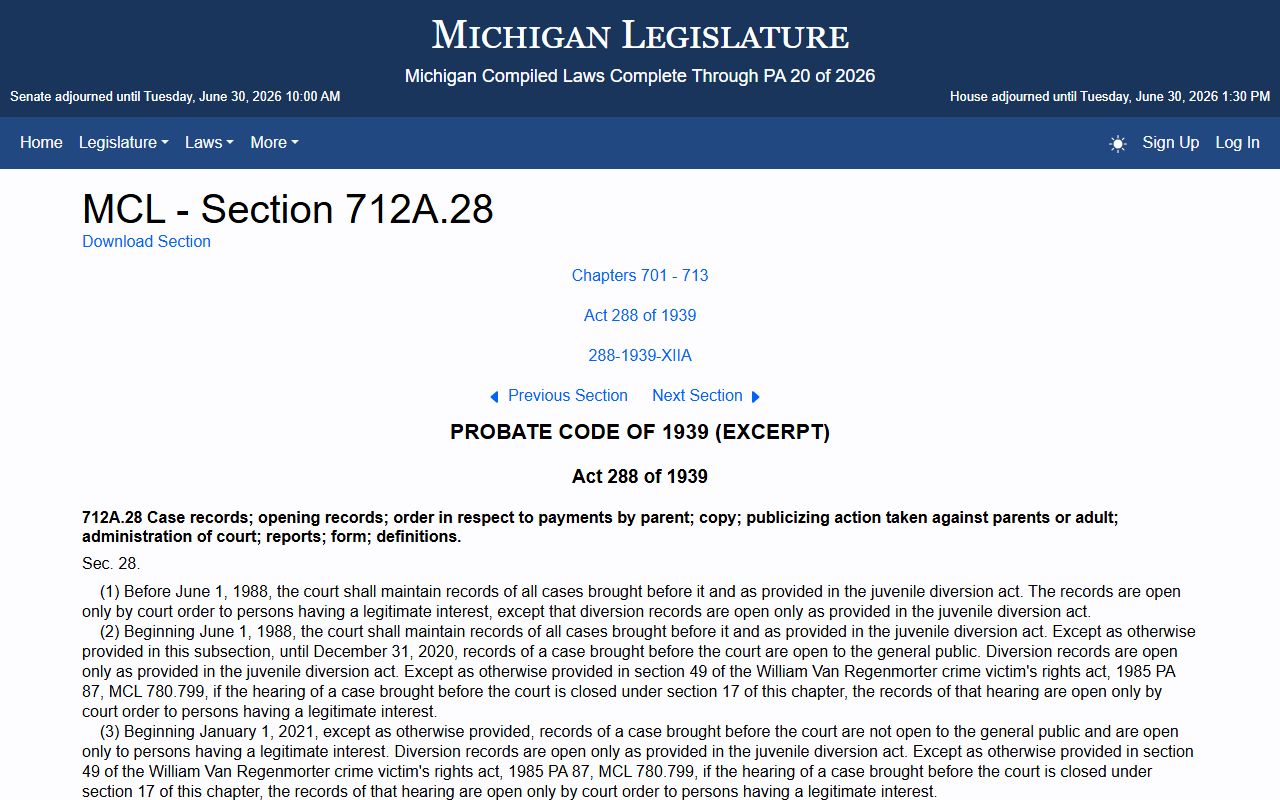
The law explains why a name search may return nothing when the underlying matter involves a minor.
Court staff also follow benchbook guidance on sealing records and handling access to closed proceedings. This Michigan Courts page on sealing records and access to closed proceedings lays out those steps.
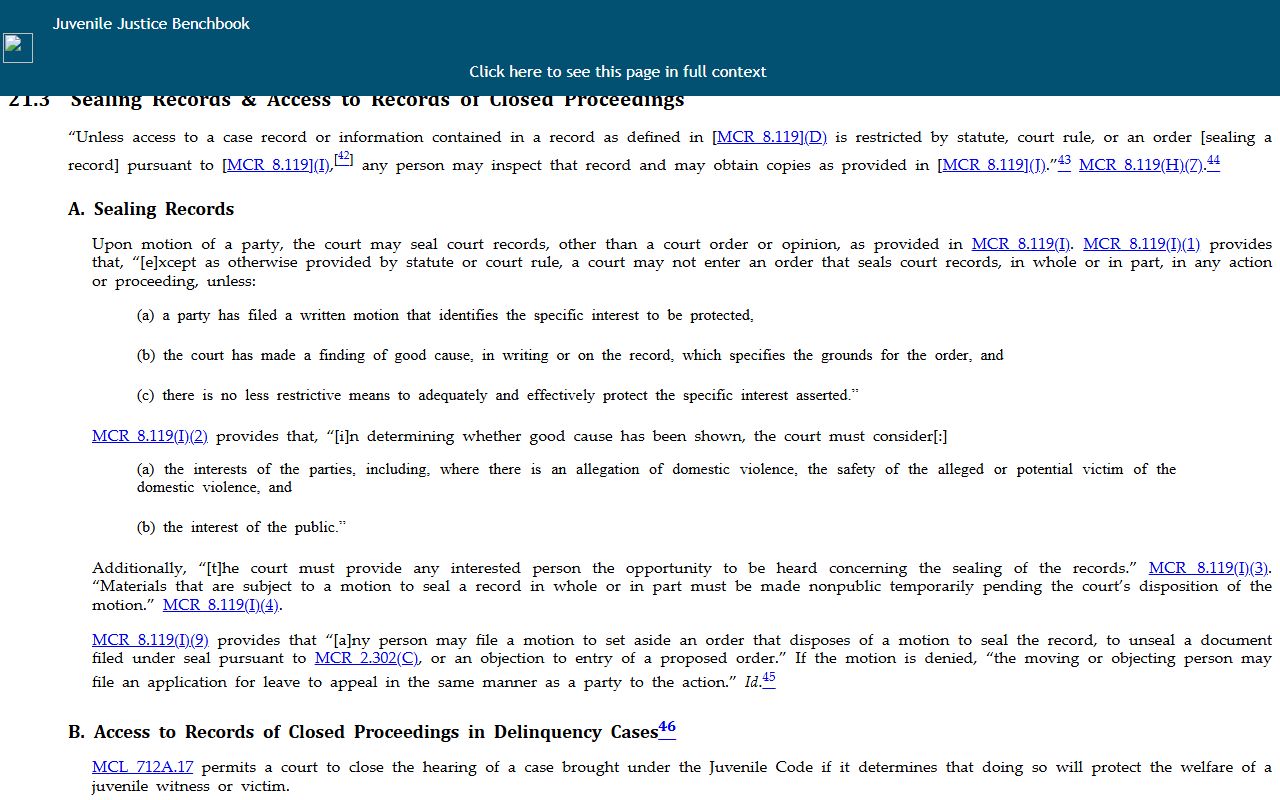
Together these rules mean a Dickinson County probate search can miss records that exist but stay sealed by order or by law.